Seven Common Mistakes New Writers Make When Editing Their Own Work
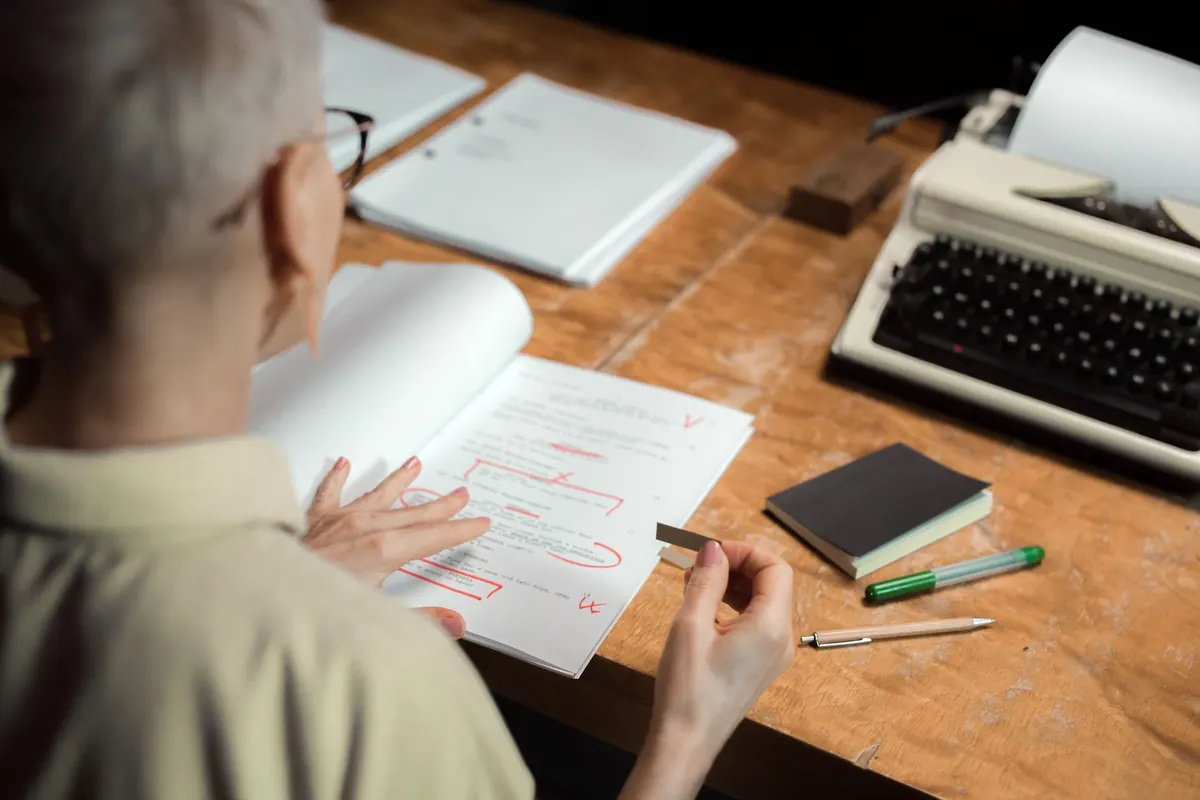
You finish a draft, feel pleased with yourself for about four minutes, then open the file again and start changing "walked" to "strode" and back to "walked". Self-editing is the part of writing nobody prepares you for. It is not one skill but several, and most new writers try to perform all of them at once, on the same paragraph, at eleven o'clock at night.
What follows is a diagnostic list. Find the mistake that sounds most like you, apply the fix, and leave the rest for another draft.
You polish the opening until it gleams
You have read your first page so many times you can recite it. Chapter one is immaculate. Chapter nine still contains a note to yourself that reads "something happens here". This is procrastination dressed as diligence: perfecting the part you already know how to write because the rest is harder.
Fix: give your opening one pass, then forbid yourself from returning to it until you have edited the whole manuscript. Leave a comment if you must. You will edit that opening far better once you know what the ending does — and you will probably cut half of it.
You edit sentences before you check the structure
Line editing a scene that should not exist is wasted effort. Before you fuss over word choice, make sure the architecture holds. A reverse outline is the quickest way to see it: go through the draft and write one line per scene or section describing who wants what and what changes by the end.
Read that list on its own, away from the prose. You will spot two scenes doing the same job, a character who vanishes for eighty pages, a revelation that arrives without any groundwork. Cutting and reordering feels brutal, but it saves you polishing sentences you are about to delete.
You read only with your eyes, on a screen
Silent reading on a screen is the worst possible way to catch your own errors. Your brain recognises the shape of familiar words and quietly supplies whatever is missing, so a dropped "not" or a doubled "the" sails straight past.
Fix: change the conditions. Read aloud — you will hear the sentence that runs out of breath and the paragraph where four sentences in a row begin the same way. Print it and edit on paper; the change of medium slows you down. Change the font and the size. When you are hunting typos rather than sense, read a paragraph backwards, sentence by sentence, so meaning cannot paper over the mistakes.
You lose track of continuity
Continuity errors are the ones readers write to you about. A character's eyes change from green to grey. A phone call happens in the kitchen, and two pages later they are in the car with no mention of leaving. Timelines are worse: "three days later" that does not add up, or a summer festival where everybody is wearing a coat.
Fix: keep a continuity sheet in a separate file, and update it as you edit rather than trying to hold it all in your head. Track:
- Names, spelled one way throughout, including nicknames and titles
- Appearance: age, height, hair, distinguishing features, injuries
- Timeline: dates, seasons, how long journeys take, how old people are
- Places: the layout of a house, which side of the street, what a window looks onto
- Objects: who owns what, where it is, whether it has been lost or broken
- Knowledge: who knows what, and the scene in which they found out
- Rules of your world, whether that means magic, technology or a workplace
You treat style rules as laws
Somewhere along the way, advice turns into commandments: never use adverbs, avoid the passive voice, never write "said" with anything attached to it. These are tendencies, not laws, and blindly obeying them produces prose that is technically clean and completely flat.
Cut "shouted loudly" — the adverb repeats the verb. Keep "said quietly" if the quiet matters. The passive voice exists because sometimes the object of a sentence is more important than whoever did the thing: "The letter was posted on Tuesday" is not a failure, it is a choice about emphasis.
Fix: when a rule tells you to change a sentence, ask what it loses and what it gains. If you cannot answer, leave the sentence alone.
You sand off your own voice
Editing can make writing more correct and less alive. You swap the odd, specific word for a tidier one. You smooth out a sentence that had a rhythm to it because the rhythm felt untidy. Your voice lives in exactly those irregularities, and it is easy to erase them in the name of clarity.
Fix: keep a small file of sentences you are genuinely proud of, pulled from your own drafts. When an edit makes a line more correct but flatter, read it aloud. If it now sounds like a report, put the original back.
You stop after one pass and trust the spellchecker
One trip through a manuscript is a read, not an edit. Structure, continuity, rhythm, sense and spelling are five different jobs, and they cannot all be done well in the same sitting. Grammar checkers, meanwhile, will happily pass "their going to the shops" and "he lead the way", because both words exist.
Fix: keep a personal list of the errors you actually make — its and it's, lead and led, complement and compliment, practise and practise, licence and license, discreet and discrete — and search for those words deliberately as a final check.
A routine that holds up
None of this needs talent. It needs you to separate jobs that are usually done together, and to do them in the right order.
- Leave the draft alone for at least a few days, ideally longer.
- Read it once without changing anything, making notes only.
- Do the structural pass first, with a reverse outline in front of you.
- Then the continuity pass, updating your sheet as you go.
- Then read aloud, fixing rhythm and repetition as you hear them.
- Then work at sentence level, one scene at a time.
- Proofread last, on paper if you can, hunting your own known errors.
- Then hand it to a reader and resist the urge to explain anything.
Editing is not proof that your first draft was bad. It is simply the stage where you find out what you actually wrote — which is a different thing from what you meant to write, and usually a more interesting one.
Photo: Ron Lach / Pexels